Groundbreaking trials in cardiometabolic therapeutics
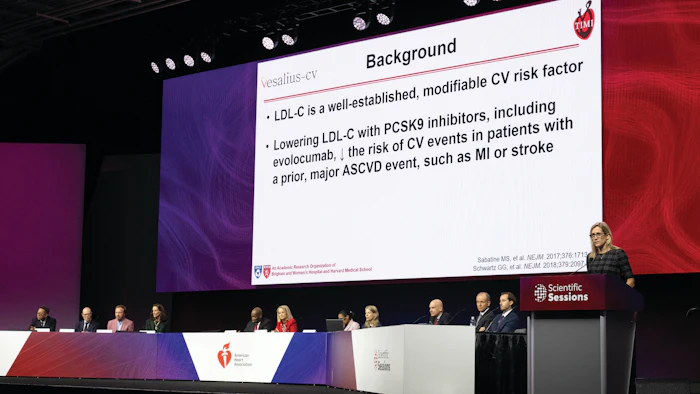
Researchers from four trials reported their findings at Saturday’s “Groundbreaking Trials in Cardiometabolic Therapeutics” session. They found that:
- PCSK9 inhibitor reduced cardiovascular events in patients with a history of atherosclerosis or diabetes but without a prior myocardial infarction (MI) or stroke.
- Novel RNA-targeted therapy reduced triglycerides and pancreatitis risk in patients with severe hypertriglyceridemia.
- ANGPTL3 gene editing significantly reduced LDL cholesterol and triglycerides in patients with refractory homozygous familial hypercholesterolemia.
- Novel triple agonist targeting fibroblast growth factor 21, glucagon and glucagon-like peptide-1 receptors rapidly and significantly reduced triglycerides, atherogenic lipids and liver fat in adults with severe hypertriglyceridemia.
PCSK9 inhibitor significantly reduced cardiovascular events in patients with a history of atherosclerosis or diabetes
Low-density lipoprotein cholesterol (LDL-C) is a well-established modifiable cardiovascular risk factor. Proprotein convertase subtilisin/kexin type 9 (PCSK9) inhibitors lower LDL-C and have been shown to reduce the risk of recurrent cardiovascular events in patients with a history of a prior major cardiovascular event, such as MI or stroke. The Effect of Evolocumab in Patients at High Cardiovascular Risk Without Prior MI or Stroke: Primary Results of the VESALIUS-CV trial evaluated if Evolocumab, a PCSK9 inhibitor, could reduce the risk of a first major cardiovascular event in a lower-risk population than previously studied. The global randomized phase 3 double-blind, placebo-controlled trial that included 12,257 patients with known atherosclerotic cardiovascular disease (ASCVD) or diabetes but without a history of heart attack or stroke. Patients had either LDL-C ≥90 mg/dL, non-high-density lipoprotein cholesterol (non-HDL-C) ≥120 mg/dL or apolipoprotein B ≥80 mg/dL and had been treated with optimized lipid-lowering therapy. Participants were randomized to receive Evolocumab or placebo in addition to continuing to receive optimized lipid-lowering therapy and followed for a median of 4.6 years.
Evolocumab significantly reduced the risk of the dual primary endpoints with a 25% reduction in coronary heart disease death, MI or ischemic stroke and a 19% reduction in the expanded endpoint that included ischemia-driven arterial revascularization compared to placebo. Findings for the dual primary endpoints were consistent across key subgroups, including in those with diabetes without qualifying atherosclerosis, which represented approximately one third of the study population. Evolocumab also reduced the risk of multiple secondary endpoints, including a 27% reduction in cardiovascular death, MI or ischemic stroke and a 36% reduction in MI.
“Results from VESALIUS-CV represent the first demonstration of improved cardiovascular outcomes with a PCSK9 inhibitor, or any non-statin for that matter, in patients without a prior MI or stroke already treated with a high-intensity lipid-lowering regimen,” said principal investigator Erin Bohula, MD, DPhil, an associate physician in cardiovascular medicine at Brigham and Women’s Hospital and assistant professor of medicine at Harvard Medical School. The study was simultaneously published in The New England Journal of Medicine.
“Our findings support the use of intensive LDL-C lowering to achieve targets of ~40mg/dL even in the lower risk patients, like those included in the VESALIUS-CV study without a prior major cardiovascular event of MI or stroke to prevent the first major cardiovascular event,” she said.
Novel mRNA-targeting therapy significantly lowered triglycerides in patients with severe hypertriglyceridemia, impacting pancreatitis risk
Olezarsen, an antisense oligonucleotide messenger RNA-targeting therapy for apolipoprotein C-III, a key regulator of triglyceride metabolism, significantly lowered triglycerides in patients with severe hypertriglyceridemia (HTG), according to findings in the CORE-TIMI 72a and CORE2-TIMI 72b trials.
In the international double-blind placebo-controlled phase 3 trials, a total of 1,063 patients, 617 in CORE-TIMI 72a and 444 in CORE2-TIMI 72b, with HTG defined as a serum triglyceride concentration ≥500 mg/dL despite background lipid-lowering therapy were randomly assigned in a 1:1 ratio to 50 mg or 80 mg dose groups. Within those groups, participants were randomized in a 2:1 ratio to olezarsen or matching placebo, given subcutaneously monthly for 12 months. The primary endpoint was the percent change in triglycerides from baseline to six months reported as the difference between olezarsen and placebo. Pooled analysis of CORE-TIMI 72a and CORE2-TIMI 72b were also used to assess olezarsen’s effect on acute pancreatitis events and change in hepatic steatosis. Overall, olezarsen lowered triglycerides by 55% to 72% with the 80 mg dose and 49% to 63% with the 50 mg dose, compared to placebo.
“This is more than what can be achieved with conventional triglyceride-lowering therapies,” said principal investigator Nicholas Marston, MD, MPH, a cardiologist at the Brigham and Women’s Hospital in Boston. Of enrolled patients, 85% of those taking olezarsen achieved triglycerides levels below 500 mg/dL, shifting them out of the severe range.
“Most importantly, olezarsen also markedly reduced the risk of acute pancreatitis, with an 85% relative risk reduction,” he said. Marston noted that this result is clinically meaningful because patients with persistently severe hypertriglyceridemia and chylomicronemia are at high risk of acute pancreatitis, and some may develop recurrent pancreatitis that is difficult to prevent.
“Olezarsen will be a game-changer for these patients, as most will be able to achieve triglyceride levels well below the risk threshold for acute pancreatitis,” he said. The study was simultaneously published in The New England Journal of Medicine.
CRISPR/Cas9-based editing of ANGPTL3 shows potential for managing patients with refractory LDL and triglyceride disorders
Despite lipid-lowering therapy, many patients can’t achieve effective control of hypercholesterolemia or hypertriglyceridemia. Angiopoietin-like protein (ANGPTL3) plays an important role in lipid metabolism. Genetic studies have shown that ANGPTL3 loss of function variants are associated with lower levels of low-density lipoprotein (LDL) cholesterol and triglycerides and a lower lifetime risk of atherosclerotic cardiovascular disease. Could a one-time therapy to silence the expression of ANGPTL3 simultaneously address and reduce elevated LDL/ triglyceride? That was the question asked in the First-in-Human Phase 1 Clinical Trial of a CRISPR-Cas9 Gene Editing Therapy Targeting ANGPTL3.
In the open label multicenter, phase 1a/1b study, which is the first report of CRISPR-CAS9 gene editing of ANGPTL3 within the liver (CTX310) in humans with uncontrolled levels of cholesterol or triglycerides despite use of maximally tolerated lipid lowering therapy, 15 patients with homozygous familial hypercholesterolemia, heterozygous familial hypercholesterolemia, severe hypertriglyceridemia or mixed dyslipidemias received a single intravenous ascending dose escalation of CTX310 (0.1, 0.3, 0.6, 0.7 and 0.8 mg/kg). CTX310 consisted of Cas9 mRNA and guide RNA (sgRNA) targeting ANGPTL3 encapsulated in lipid nanoparticles. Patients were followed for at least 60 days. The primary endpoint was the preliminary efficacy, including changes in LDL, triglyceride and ApoB, ApoC-III, non-HDL cholesterol and remnant cholesterol compared to baseline and safety outcomes, including dose-limiting toxicities. Safety and tolerability were assessed during follow-up with biomarkers collected to assess lipid effects and liver safety.
Of enrolled patients, ANGPTL3 was reduced by up to 79.7%, LDL cholesterol was reduced by up to 48.9% and triglycerides by up to 62%. No serious adverse events (SAEs) related to CTX310 occurred; two participants experienced serious adverse events not related to CTX310. Three patients experienced infusion-related reactions, and one patient had a transient increase in liver enzymes.
“These findings suggest that ANGPTL3 gene editing has the potential to produce highly effective reductions in LDL cholesterol and triglycerides,” said study investigator Stephen Nicholls, MBBS, PhD, director of the Monash Victorian Heart Institute in Melbourne, Australia. Nicholls noted that although the tolerability and potential efficacy of CTX310 presents a potential new pathway for once-in-a-life time treatment of dyslipidemia, larger studies are needed to determine its long-term efficacy. The study was simultaneously published in The New England Journal of Medicine.
Novel drug targeting GLP-1, GCGR and FGF21 receptors improved triglycerides, liver fat and atherogenic lipids in patients with severe hypertriglyceridemia
DR10624, a long-acting first-in-class triple agonist targeting fibroblast growth factor 21 receptor (FGF21R) glucagon receptor (GCGR) and glucagon-like peptide-1 receptor (GLP-1R), demonstrated a favorable safety and tolerability profile, as well as a statistically significant reduction in triglycerides, liver fat and various atherogenic lipids in patients with severe hypertriglyceridemia (SHTG), according to primary results from DR10624, a randomized phase 2 trial in patients with SHTG.
The 12-week double-blind placebo-controlled study randomized 79 adults with SHTG in a 3:1 ratio to receive DR10624 in three different doses: 12.5 mg, 25 mg and 50 mg titration or placebo by weekly subcutaneous injections for 12 weeks. The primary endpoint was the percent change in fasting triglycerides from baseline to week 12. Secondary endpoints included change of lipid and lipoprotein profile, change of liver fat content, change of various metabolic markers, anti-drug antibody and responder analysis of triglyceride reduction at various threshold levels.
After 12 weeks of weekly subcutaneous administration, DR10624 resulted in median triglyceride reductions ranging from -66.2% to -74.5%, compared to an -8% reduction in the placebo group. Moreover, a significantly higher proportion of patients treated with DR10624, compared to those treated with placebo achieved key clinical milestones, including triglyceride levels below 500 mg/dL (89.5% vs. 25.0%), a ≥50% reduction in triglycerides (78.5% vs. 5.0%) and triglyceride normalization, fasting TG<150 mg/dL) (19.1% vs. 0%). DR10624 was well tolerated and showed a favorable safety profile.
The study also found significant improvements in key atherogenic lipids, including total cholesterol, high-density lipoprotein cholesterol (HDL-C), non-HDL-C levels, very low density lipoprotein cholesterol (VLDL-C), and triglyceride-rich lipoprotein cholesterol (TRL-C), and resulted in significant reduction in liver fat (-63.2% vs. -8.4%) compared to placebo, an outcome not typically seen with current triglyceride-lowering therapies.
“These results are important because existing treatments for severe hypertriglyceridemia, such as fibrates and omega-3 fatty acids, often fail to achieve significant reductions in triglycerides or improve related metabolic conditions,” said principal investigator Jianping Li, MD, PhD, chief of the Institute of Cardiovascular Disease at Peking University First Hospital. “The rapid and profound triglyceride-lowering efficacy of DR10624 could address an unmet need for more effective therapies. More importantly, DR10624 not only targets triglycerides but also addresses other components of lipid metabolism, especially liver fat, which is critical for improving long-term health outcomes in the patient population with SHTG.”Li noted that if these promising findings can be confirmed in larger and longer phase 3 trials, DR10624 could become an innovative therapy for improving triglyceride control, metabolic health and liver function in patients with severe hypertriglyceridemia.