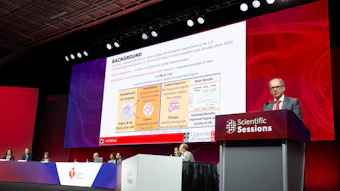
After MI: Trailblazing treatments for saving more lives

In the quest to prevent recurrent cardiovascular events, the pharmacological toolbox is brimming with new possibilities.
Roxana Mehran, MD, FAHA, FACC, FSCAI, FESC, said major advances in recent decades have dramatically improved outcomes for patients with MI — a total of about 805,000 people in the United States each year. Yet, with an estimated 200,000 recurrent MIs annually, new therapies in secondary prevention are so critical.
Mehran, who is 2025-26 vice president of the American College of Cardiology, will explore new post-MI therapies Saturday at the TCT at AHA session, “ACS/STEMI: What We Have Accomplished and Where We Are Going.”
The session will examine the latest strategies in acute MI care, including complete revascularization and the evolving role of physiology and imaging. Mehran’s presentation, “Beyond Antithrombotics: Lipid-Lowering and Anti-Inflammatory Therapies Post-MI,” will focus on how secondary prevention is evolving beyond antithrombotics and statins, the traditional cornerstones of post-MI therapy.
“Novel lipid-lowering therapies administered early after MI can achieve aggressive LDL reduction and stabilize vulnerable plaques,” said Mehran, professor of medicine in cardiology, population health science and policy at the Icahn School of Medicine at Mount Sinai in New York City.
“There is also the emerging concept of inflammation as a key driver of recurrent events,” she said. “Strategies include targeting both the acute inflammatory burst in the early phase of MI and addressing chronic, low-grade residual inflammatory risk that contributes to long-term adverse outcomes.”
On the lipid-lowering side, statins remain the foundation and have been in use for decades. But Mehran said newer treatments like PCSK9 inhibitors — such as monoclonal antibodies alirocumab and evolucumab and the small interfering RNA drug inclisiran — are gaining ground, providing powerful LDL reductions.
“They are increasingly used in high-risk patients not at goal on statins,” she said. “Novel evidence suggests they contribute to plaque stabilization and are particularly useful for rapidly lowering LDL, especially after an MI — the so-called strike early, strike strong strategy.”
Further out on the cutting edge, Mehran said lipoprotein(a) therapies are still in the investigational stages but have shown great promise treating patients with established atherosclerotic cardiovascular disease.
“Elevated Lp(a), a genetically determined risk factor, is considered a major contributor to residual cardiovascular risk,” she explained. “Agents using antisense oligonucleotides or siRNA are in late-stage trials but not yet approved. These represent a promising frontier in addressing an otherwise untreated pathway.”
On the inflammatory side, colchicine is currently the only therapy with guideline recommendations and Food and Drug Administration approval for use in post-acute MI settings. Mehran said it’s an inexpensive, oral anti-inflammatory drug that has been used for decades to treat gout and pericarditis. Its use as a post-MI therapy is a relatively new development, after randomized cardiovascular trials showed that low-dose colchicine reduces recurrent ischemic events after MI.
“It is the first anti-inflammatory therapy formally recognized in this setting,” Mehran said. “That said, its clinical implementation is sometimes limited by side effects such as gastrointestinal intolerance.”
Meanwhile, additional experimental approaches to post-acute MI care include IL-1β inhibitors such as canakinumab.
“IL-1β inhibition with the antimonoclonal antibody canakinumab demonstrated a reduction in cardiovascular events in the landmark CANTOS trial,” she said, adding that the drug hasn’t been approved for cardiovascular prevention due to high cost and infection risk.
“Nevertheless, the study provided proof of concept that inflammation can be targeted in this population,” she said.
Another experimental approach that shows promise is IL-6 inhibition aimed at reducing vascular inflammation.
“IL-6 inhibition with compounds such as ziltivekimab remains investigational,” Mehran said. “Large-scale outcomes in trials in MI patients are ongoing, and if positive, these therapies could provide a new pathway to reduce inflammatory risk, targeting both acute and chronic inflammation.”
Interleukins such as IL-1β and IL-6 are central mediators in the inflammatory cascade that contribute to atherosclerosis progression and recurrent cardiovascular events, she said. By blocking these pathways, anti-interleukin therapies aim to directly reduce vascular inflammation beyond what lipid- or thrombosis-targeted therapies can achieve.
In addition to Mehran’s presentation, the session will feature presentations on strategies in acute MI care from William Fearon, MD, professor of cardiovascular medicine and chief of the Interventional Cardiology Section at Stanford University School of Medicine in Palo Alto, California; Gary Mintz, MD, chief medical officer of the Cardiovascular Research Foundation in New York City; and Renato Lopes, MD, PhD, FACC, professor of medicine (cardiology) and member of the Duke Clinical Research Institute for Cardiology at Duke University in Durham, North Carolina.