Scientific Sessions: An oasis of rational optimism

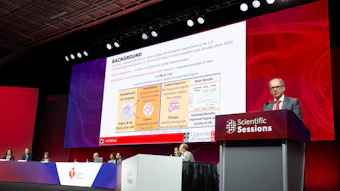
Hope and progress are rarely found in isolation — and that, said Joanna Chikwe, MD, FRCS, FAHA, is precisely the point of the American Heart Association’s Scientific Sessions. Opening this year’s meeting, she invited attendees to see the gathering as “an oasis of rational optimism,” a space where science and compassion converge to drive meaningful change in cardiovascular care.
Chikwe, professor and chair of cardiac surgery at the Smidt Heart Institute at Cedars-Sinai and chair of the 2025 Committee on Scientific Sessions Program, began her remarks with a patient experience. “You may be wondering why a cardiac surgeon would spend time away from the operating room to organize a meeting for cardiologists and scientists,” she said. “To answer that question, and remind us why we’re all here, I want to tell you a story.”
She described the story of her patient Blair Bellamy, “a tall, rangy, 74-year-old who had always been fit.” Two years ago, while in his kitchen with his wife, Bellamy collapsed. “He remembers nothing,” Chikwe said. His wife “remembers everything — from calling 911 to neighbors performing CPR on her husband on their kitchen floor until the ambulance crew arrived.”
Those neighbors sustained him for six minutes until paramedics arrived and defibrillated him twice. At Cedars-Sinai, Bellamy was stabilized, cooled to preserve brain function and treated for heart failure caused by mitral prolapse.
“Three days later, Blair woke up,” Chikwe said. “Two weeks later, he left the hospital with an ICD. And two years later, he is working as a part-time librarian, and back to hiking the trails in his spare time.” Eventually, Chikwe repaired his mitral valve robotically: “He went home three days later, with no regurgitation, a normal ejection fraction and a tiny incision in his right side.”
For Chikwe, the story carries a larger message.
“The most important aspect of this story is the impact on a person and a family,” she said. “His personal journey is absolutely unique. But the medical story here is far from unique, and that is why I wanted to share it with you today.”
That balance of human experience and scientific achievement sets the tone for this year’s meeting. “To celebrate what we’ve accomplished as a specialty and highlight how this amazing community is finding explanations and solutions that transform cardiovascular and brain health, and millions of lives,” she said.
Chikwe reflected on the progress since the last time Scientific Sessions was held in New Orleans — and the last time a surgeon organized the meeting — in 2016. “At the time, heart failure carried a median two-year survival, GLP-1s were barely on the horizon and AI was the stuff of science fiction,” she said. “Today, we’re identifying risk factors for sudden cardiac death, and we’ve transformed the treatment of heart failure. Mitral repair is routinely performed with near-zero mortality. We’re doing this work in truly unprecedented times.
“Blair’s story reminds us why this work matters and why gatherings like Scientific Sessions exist — to turn discovery into better outcomes for patients.”

Recipients of this year’s Distinguished Scientists Awards were recognized by
Stacey Rosen, MD, FAHA (far right).
Pictured left to right:
Donna K. Arnett, PhD, MSPH, FAHA
Christie Ballantyne, MD, FAHA
Daniel P. Kelly, MD, FAHA
Steven E. Lipshultz, MD, MA, FAHA
Sanjay Rajagopalan, MD, MBA, FAHA
Sylvia Wassertheil-Smoller, PhD, MS, FAHA
More about these awardees and their accomplishments can be found in the Saturday edition of the Scientific Sessions Daily News.
Also recognized:
Fatima Rodriguez, MD, MPH, FAHA, a leading preventive cardiologist and clinical researcher, was selected for the Joseph A. Vita Award. She is section chief of preventive cardiology and vice chair of clinical research in the Department of Medicine at Stanford University, and associate director of the Stanford Center for Digital Health.
Megan McLaughlin, MD, MPH, was recognized for the Nanette K. Wenger Award. She was selected for her article “Disparities in Postpartum Care After a Hypertensive Disorder of Pregnancy in the United States,” which was published in Hypertension in April 2025.