Reports find multiple approaches improve outcomes after stroke

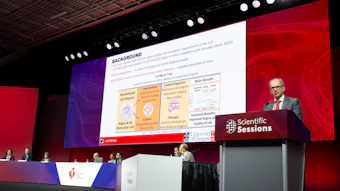
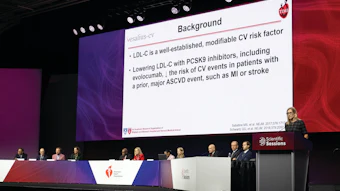
Results from three Late-Breaking Science trials were presented during Saturday’s Main Event. Research found:
- OCEANIC-STROKE showed Factor XIa inhibitor, asundexian, benefit for secondary stroke prevention across all nonlaboratory Framingham Risk Score categories among patients with noncardioembolic stroke or high-risk transient ischemic attack.
- REDUCE found spironolactone-based treatment lowered home systolic blood pressure after stroke by nearly 8 mmHg more than standard care.
- OPTIMAL-STROKE confirmed systolic blood pressure <120 mmHg improved secondary stroke prevention.
OCEANIC-STROKE showed asundexian lowered ischemic stroke regardless of Framingham Risk Score category
An exploratory post-hoc analysis of the OCEANIC-STROKE trial of oral asundexian vs. placebo for secondary stroke prevention showed the first-in-class Factor XIa (FXIa) inhibitor had similar efficacy and safety regardless of patients’ baseline Framingham Risk Score (FRS) category. The primary analysis, presented at the International Stroke Conference earlier this year, reduced the risk of recurrent ischemic stroke by 26% compared to placebo among patients with recent noncardioembolic ischemic stroke or high-risk transient ischemic attack. Efficacy was consistent across index stroke subtypes, including large artery atherosclerosis, small vessel occlusion or undetermined stroke. There was no interaction between asundexian efficacy or safety and FRS category.
Patients at high risk by FRS were more likely to be older, male, have large artery atherosclerosis and be slated for dual antiplatelet therapy and less likely to be Asian than low- or medium-risk patients. But there was no statistically significant interaction between treatment effect and FRS category for ischemic stroke; a composite of cardiovascular death, myocardial infarction, stroke; major bleeding or clinically relevant nonmajor bleeding; minor bleeding; and net clinical benefit outcomes. This post-hoc analysis of the trial included a total of 12,264 patients with complete FRS data.
 Mukul Sharma, MD
The one caveat, he noted, was relatively small numbers of individuals in the low-risk category. The small numbers in the low-risk group led to wider confidence intervals than in the intermediate- and high-risk groups, but no significant interaction between treatment and FRS category was clear across all three risk groups for all efficacy and safety outcomes.
“This essentially coincides with what we found in the initial analysis, that asundexian worked well, and a second analysis where we saw good efficacy and safety across the various stroke subtypes,” Sharma said. “It’s not the case that one has to think very hard about what the patient’s risk is and what exactly the risk factors are before determining eligibility for asundexian. It seems to work well across a number of risk strata. The major clinical implication is that it is easy to use for a wide variety of patients.”
Asundexian is the FXIa inhibitor to reach phase 3 trials. A second agent, milvexian, may report top-line phase 3 results in early 2027.
“This is the first agent in the class, and I expect it to have an effect on guidelines,” Sharma said. “If there are two trials, both of which show similar results, it becomes much easier for guideline writers to revisit secondary stroke prevention.”
Asundexian is the first FXI/FXIa inhibitor to reach phase 3 trials. A second agent, milvexian, may report top line phase 3 results in early 2027.
“This is the first agent in the class and I expect it to have an effect on guidelines,” Sharma said. “If there are 2 trials, both of which show similar results, it becomes much easier for guideline writers to revisit secondary stroke prevention.”
Spironolactone-based treatment lowered post-stroke blood pressure nearly 8 mmHg vs. usual care
Hypertension is the leading modifiable risk factor for recurrent stroke, yet post-stroke blood pressure control remains suboptimal. A randomized, open-label trial comparing spironolactone-containing blood pressure regimens following ischemic stroke or intracerebral hemorrhage (ICH) found clinically significant and durable reductions in home blood pressure compared to usual care. Initial results of the “Regulating Blood Pressure During Recovery From Intracerebral Hemorrhage and Ischemic Stroke (REDUCE) Trial” showed a mean difference in home systolic blood pressure of 7.7 mmHg at three months and 6.9 mmHg at six months compared to standard care.
 Jordana Cohen, MD, MSCE, FAHA
REDUCE randomized 160 patients following ischemic stroke or ICH across five U.S. centers to either a spironolactone-based blood pressure regimen (85 patients) or standard care (75 patients), in which treating clinicians received a letter summarizing 2017 ACC/AHA high blood pressure guideline recommendations for stroke survivors. The mean age of trial participants was 63 years; 37% were female and 29% Black; 54% had ICH and 46% had ischemic stroke. The mean baseline systolic blood pressure was 136 mmHg, and participants were taking a mean of two antihypertensive medications.
The primary outcome was home systolic blood pressure (SBP) at three months. Secondary outcomes included home diastolic blood pressure (DBP) at three months, home SBP/DBP at six months, the number of concomitant antihypertensive medications at three months and the proportion achieving blood pressure target of <130/80 mmHg at three months.
At three months, the spironolactone group had a mean SBP of 125.6 mmHg vs. 133.3 mmHg for standard care, a mean difference of -7.7 mmHg (95% CI: [-11.6, -3.8], p=0.0002). The difference was similar at six months: 124.0 vs. 130.9 mmHg, a mean difference of -6.9 (95% CI: [-10.6, -3.2], p=0.0004). Participants in the spironolactone group were taking more antihypertensive medications at 3 months, including spironolactone: 2.6 vs. 2.1, for a mean difference of 0.5 (95% CI: [0.2, 0.9], p=0.004).
Serious adverse event rates were similar: 15% for spironolactone vs. 16% for standard care. Spironolactone showed higher rates of hypotension (8% vs. 1%), lightheadedness (5% vs. 1%) and hyperkalemia (4% vs. 0%) vs. usual care. The trial was not powered to assess recurrent stroke or other clinical events. Enrollment closed early at 160 of the planned 200 participants because of slow recruitment, and 15% of participants lacked the 3-month primary outcome; a multiple imputation analysis including all 160 participants showed a similar difference of -6.9 mmHg (95% CI: [-10.7, -3.0]).
“Every way we looked at blood pressure, patients had about an
8 mmHg lowering of systolic blood pressure,” Cohen said. “And just over half of patients achieved a blood pressure goal of less than 130/80 mmHg in the spironolactone group, compared to 30% in the usual care group. We should be thinking about blocking aldosterone earlier in the treatment of hypertension after stroke.”
Clinical benefits to systolic blood pressure <120 mmHg after ischemic stroke or TIA
A randomized trial of blood pressure control in more than 4,000 ischemic stroke or transient ischemic attack survivors showed a 21% relative reduction in subsequent major cardiovascular events for systolic blood pressure <120 mmHg compared to standard care, which was defined as a systolic blood pressure target <140 mmHg. The median follow-up was 3.9 years.
 Gisele Sampaio Silva, MD, MPH, PhD
The OPTIMAL-STROKE trial directly compared two approaches to blood pressure control after ischemic stroke. The trial randomized 4,368 participants from 30 sites across Brazil to either intensive blood pressure control, systolic blood pressure <120 mmHg, or standard care, which the trial defined as systolic blood pressure <140 mmHg. All of the participants had a prior ischemic stroke or transient ischemic attack and high blood pressure with systolic blood pressure between 130 and 180 mmHg.
At baseline, the mean blood pressure was 146.7/81.6 mmHg. The mean age of participants was 63.9 years, and 47.9% were female. Just over half (56.8%) self-identified as white, 29.8% as mixed race and 12.1% as Black.
The primary endpoint was a composite of cardiovascular death, nonfatal myocardial infarction (MI), nonfatal stroke, hospitalization for unstable angina or hospitalization for heart failure. Secondary endpoints included the individual components of the primary outcome; a composite of cardiovascular mortality, nonfatal MI or nonfatal stroke; a composite of all-cause mortality, nonfatal MI or nonfatal stroke; hospitalization for unstable angina or heart failure; all-cause mortality and renal outcomes.
 Otavio Berwanger, MD, PhD
At 48 months, the median systolic blood pressure in the intensive treatment group was 119.9 mmHg vs. 135.2 mmHg in the standard treatment group. A primary outcome event occurred in 10.9% of the intensive control group (3.25 events per 100 person-years) compared with 13.5% of the standard treatment group (4.11 events per 100 person-years). The hazard ratio (HR) for intensive blood pressure control was 0.79 (95% CI: [0.67, 0.94], p=0.007). Event curves separated during the first few months of follow-up and continued to separate over time.
Secondary outcomes generally favored intensive BP control. The HR for cardiovascular mortality, nonfatal MI or nonfatal stroke was 0.81 (95% CI: [0.68, 0.98], p=0.03), for all-cause mortality, nonfatal MI/stroke or hospitalization for unstable angina/heart failure 0.84 (95% CI: [1.24, 0.97], p=0.02) and for stroke 0.73 (95% CI: [0.56, 0.94]). Other secondary cardiovascular outcomes were not statistically significant.
The intensive blood pressure control group had worse renal outcomes, HR 1.76 (95% CI: [1.21, 2.50]). There were similar rates of serious adverse events, orthostatic hypotension, or injuries. Berwanger noted that the increase in kidney-related events, primarily reductions in kidney function, underlines the need for individualized treatment and careful monitoring for all patients.
“Many clinicians have worried that lowering blood pressure
too far after an ischemic stroke could reduce blood flow to the brain and trigger another event,” he said. “In clinically stable patients, we saw fewer ischemic strokes, not more, with a target below 120 mmHg. It is also meaningful that we showed this benefit in a population that has been underrepresented in previous trials of intensive blood pressure lowering.”
OPTIMAL-STROKE was published simultaneously in the New England Journal of Medicine.